
Building Strong English Skills for a Brighter Future
Welcome to English on the Run.
We are an online English school that believes in creating unstoppable individuals who fearlessly express themselves in English, creating the way for endless possibility.

English for ADULTS
Elevate your global communication skills. Transform your English from uncertainty to fluency.

English for KIDS & TEENS
Empower your child to become a confident global citizen with our unique international conversation groups and global community.

Study English Abroad
Open up your perspectives take a step into a future with summer study programmes abroad.

Don't sign up for any business English course before doing this!
Understand where you need to focus your efforts and save your time with this ultimate 10-step guide and planner.
About Audrey, the founder of English on the Run
Hi, I'm Audrey Smith, the driving force behind English on the Run.
In 2018, I embarked on this journey with a clear vision: to revolutionize language learning through flexible and innovative approaches.
My inspiration come from my own personal experiences – I grew up in Australia but as an adult I moved to Italy, and now Palma, Spain. I know the challenges of overcoming language barriers firsthand. Navigating a foreign culture, I've felt the familiar pang of nervousness about speaking another language.
It's this empathy that guides my commitment to guide you towards unlocking your true potential in English.

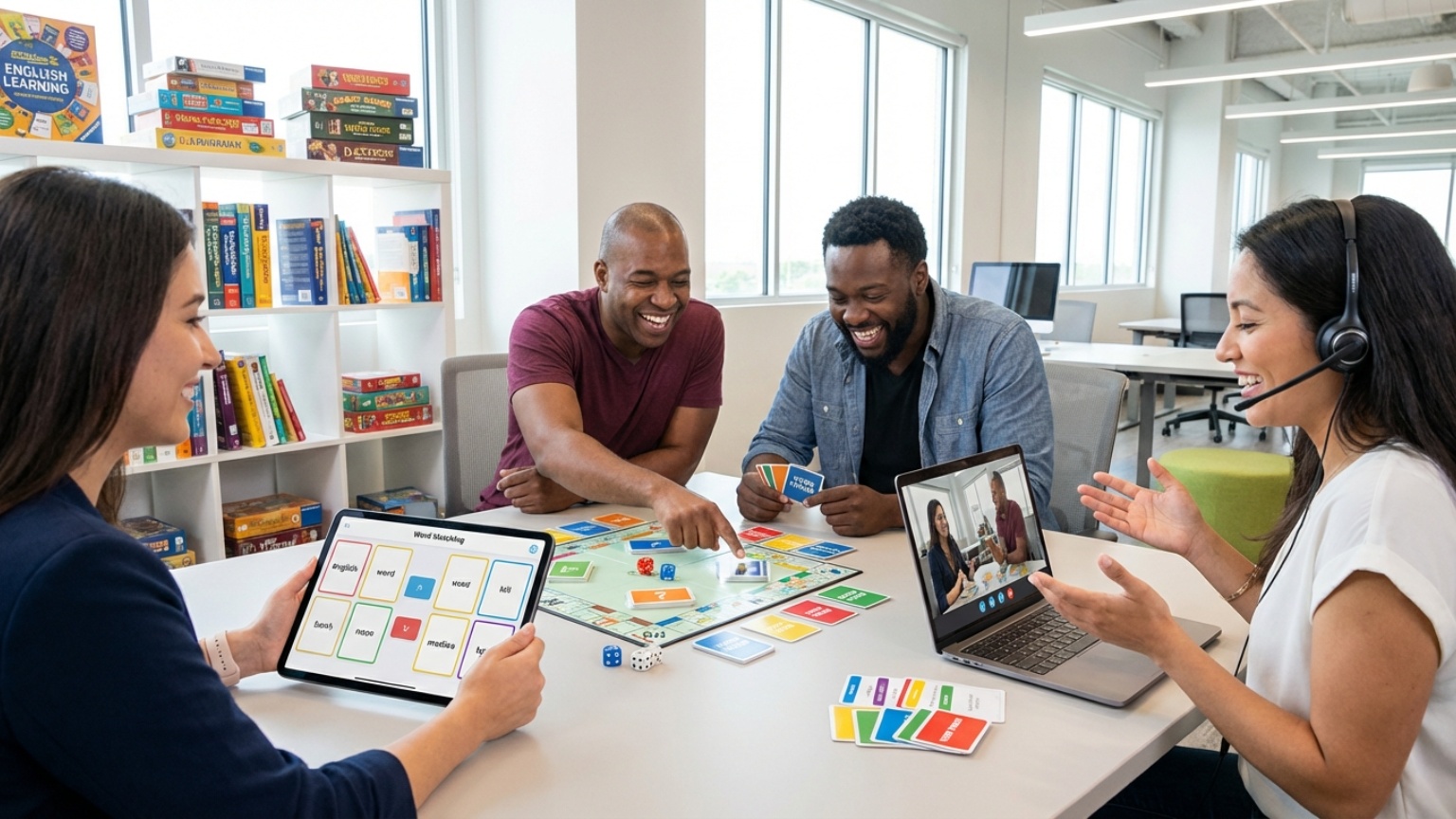
What are the best games for learning English effectively?
Do you find traditional English lessons unengaging? Many learners struggle to stay motivated with textbooks and drills. We understand that effective language acquisition needs to be enjoyable. Integrating games into your study routine can make a significant difference, transforming how you approach learning.
1. What are the types of games for learning English?
Games offer a fun and effective way to learn English. They make the learning process engaging and reduce the stress often associated with studying. Different types of games target various language skills, helping learners improve across the board. These interactive methods support progress in vocabulary, grammar,speaking, and listening.
Vocabulary-building games:These games help you learn new words and phrases. For example, apps like Quizlet or Memrise use flashcards and matching exercises. This helps to expand your word knowledge quickly.
Grammar practice games:These focus on sentence structure and rules. Many online platforms offer fill-in-the-blank or sentence reordering activities to reinforce correct grammar usage.
Role-playing and simulation games:These types of games allow you to practice speaking in real-world scenarios. You can interact with virtual characters, making conversations feel more natural and building confidence.
Listening comprehension games:These improve your ability to understand spoken English. They often involve listening to audio clips or dialogues and then answering questions about the content.
Interactive story games:These games combine reading with decision-making, improving comprehension and critical thinking. They let you follow a narrative and choose actions, which helps you understand context and plot.
Using a variety of games can create a well-rounded learning experience. They provide a dynamic approach to mastering English skills.
2. Why is the use of games beneficial for learning English?
Learning English through games offers many advantages over traditional methods. Games create an engaging and fun environment, which helps reduce the stress often linked to language acquisitionlinked language acquisition.
This approach allows learners to practice new vocabulary and grammar in a natural, low-pressure setting. For example, playing a word game can help you remember new terms more easily than just memorizing a list.
Increased Engagement:Games make the learning process enjoyable and encourage active participation from students. This fun approach helps keep learners motivated and focused for longer periods than traditional study methods.
Contextual Learning:Players learn new words and phrases by encountering them within specific game scenarios. This method helps them understand the meaning and appropriate usage of vocabulary more deeply than simply memorizing definitions.
Reduced Anxiety:The playful and less formal nature of games significantly lowers the fear of making mistakes. Learners feel more comfortable experimenting with new language structures and sounds without the pressure of formal assessment.
Practical Application:Many games require immediate use of English for problem-solving, negotiation, or communication with other players. This builds practical fluency and confidence in applying language skills to real-world situations.
Immediate Feedback:Games often provide instant feedback on whether an answer or action was correct or incorrect. This allows learners to quickly identify and correct their errors, leading to faster improvement and understanding.
Using games to learn English makes the process more effective and enjoyable. They provide a dynamic way to acquire language skills, build confidence, and ensure lasting retention.
3. How is the selection of games made for learning English?
Engagement and Motivation:Games must be enjoyable to hold a learner’s interest for a long time. When a game is fun, you will spend more time interacting with English naturally, almost without realizing it.
Targeted Language Skills:Each selected game should focus on improving a particular aspect of English proficiency. For example, a role-playing game with character dialogue helps you practice conversational English and learn new vocabulary words.
Appropriate Challenge Level:The game’s difficulty needs to match your current English proficiency level. A game that is too easy or too hard will not provide effective learning opportunities or keep you engaged.
Interactive Communication:Effective games encourage you to actively use the language in various scenarios. This might involve making choices, answering questions, or even speaking with other players to achieve game goals.
Clear Feedback and Progress:Good games provide immediate and understandable feedback on your performance. This allows you to understand your errors easily and see how your language skills are steadily improving over time.
4. What is the best way to integrate games into your English learning?
Integrating games into your English learning can make the process enjoyable and effective. However, simply playing games is not enough to see significant improvement. You need a thoughtful approach to use them as powerful educational tools. This ensures you get the most out of yourgame-based learning experience.
Choose games wisely:Select games that align with your current English level and learning goals. For example, a beginner might start with simple word puzzles, while an advanced learner could play story-rich adventure games.
Set specific goals:Before you start playing, decide what you want to improve. Perhaps you want to learn new vocabulary or practice listening comprehension.
Engage actively with language:Do more than just play. Read all in-game text, listen carefully to dialogues, and look up words you do not know. This active approach turns playtime into study time.
Review what you learn:After each session, make a quick note of new words or phrases you encountered. Reviewing these later helps you remember them better.
Mix games with other study:Games are a great supplement, but they should not be your only learning method. Combine them with grammar exercises, reading, and speaking practice for a balanced approach.
Thoughtful integration transforms games from mere entertainment into strong learning aids. By using them smartly and consistently, you can greatly improve your English skills.

Unlock your potential at our English academy
Make 2026 Your Year!


@ Copyright 2026
English on the Run| All rights reserved